The Soul Cut #07
by Etienne Delbiaggio | October 27th, 2025
There are certain types of film editing that rely on subtle techniques and creative choices designed to stimulate our psyche — to trigger emotions on an unconscious level.
One director who has extensively experimented with this approach is David Fincher, particularly in Fight Club (1999) and Se7en (1995), where the use of ghost frames plays a key role in subtly amplifying the meaning of specific scenes.
Subliminal editing

In Fight Club, following a life that leaves him deeply unsatisfied, the protagonist creates an alter ego — played by Brad Pitt — who embodies everything he himself cannot be, a sort of super-ego.
The example shown above depicts the first true introduction of this character, who will later be presented to the audience as he appears to the protagonist: a real, tangible person. Only at the film’s conclusion will both the protagonist and the audience discover the character’s true nature.
Fincher inserts a ghost frame of the alter ego during a scene in which the protagonist is speaking with a doctor about his insomnia.
Sleep deprivation is a frequent cause of hallucinations, and within the film’s context, this brief flash frame serves two purposes:
It symbolizes the birth of the alter ego within the protagonist’s mind (reinforced by the fact that the shot is from his subjective point of view).
It acts as a clue for the audience — a subliminal hint that, when Brad Pitt’s character reappears later, he will behave as though he were a real person, interacting with others throughout the story and misleading both protagonist and viewer alike.
This insertion effectively plants a seed in the viewer’s mind.
It’s worth noting that the same film later contains a scene that openly references this idea: when the character splices a pornographic frame into a family film. Though played for humor, the moment functions as a meta-commentary — a direct explanation of how subliminal frames work and how they shape perception.
This “joke” thus becomes a key to understanding the film’s narrative logic.
On a subconscious level, the viewer has glimpsed a crucial clue — even if only for a fraction of a second — through which one of the main characters has been introduced.
While the rest of the story will work to mislead us into believing he is a flesh-and-blood person (just as the protagonist does), the final revelation feels both logical and intuitively satisfying.
A different kind of subliminal editing appears in Se7en (1995).
One of the film’s unique qualities lies in how it depicts the murders committed by the serial killer.
The first killings are shown explicitly and in graphic detail, while the final ones are concealed from the viewer, culminating in the infamous climactic moment: the delivery of a box containing the severed head of the detective’s wife — which we never actually see.
The horror, however, is powerfully felt. Why? For two reasons:
The explicit violence of the earlier murders allows the audience to vividly imagine the unseen horror of the final act, guided by the detectives’ descriptions.
The film carefully builds empathy for the detective’s wife, particularly in a quiet, intimate scene where she confides her doubts and fears about her pregnancy to her husband’s partner.
This moment of vulnerability, previously unknown to us, directs the viewer’s emotions toward a predetermined destination — grief and shock at her death.
In the final confrontation, the detective faces his wife’s killer and, in that instant, learns that she was pregnant — a fact he himself did not know.
Torn between duty and vengeance, the editing inserts three fleeting frames of his wife’s face at the precise moment he looks away.
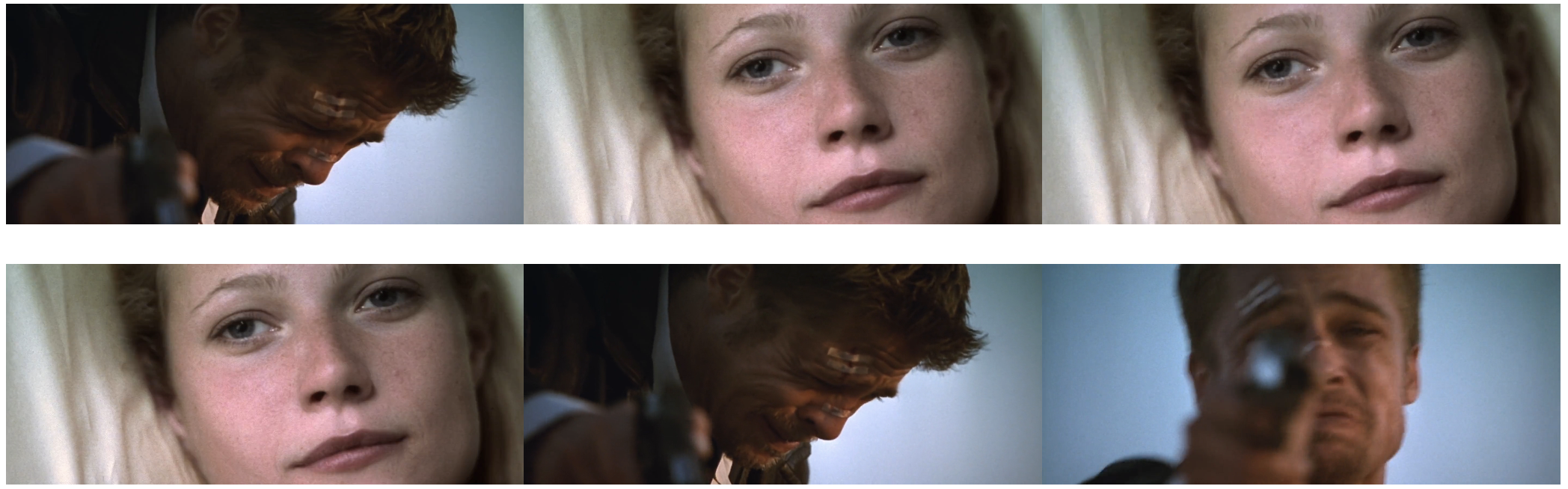
When he raises his gaze again, he executes his revenge.
These three almost invisible frames symbolize the intrusive flash of thought that overwhelms him — the emotional trigger that pushes him to pull the trigger, both literally and morally.
It’s crucial to note when these frames appear:
They are inserted the instant the man averts his gaze — a moment when pain takes over and rational thought falters, allowing subconscious emotion to dictate action.
Remaining in the realm of the subliminal, let’s shift to the importance of title design in cinema.
Continuing with Fincher, one notable example is the opening sequence of Zodiac (2007).
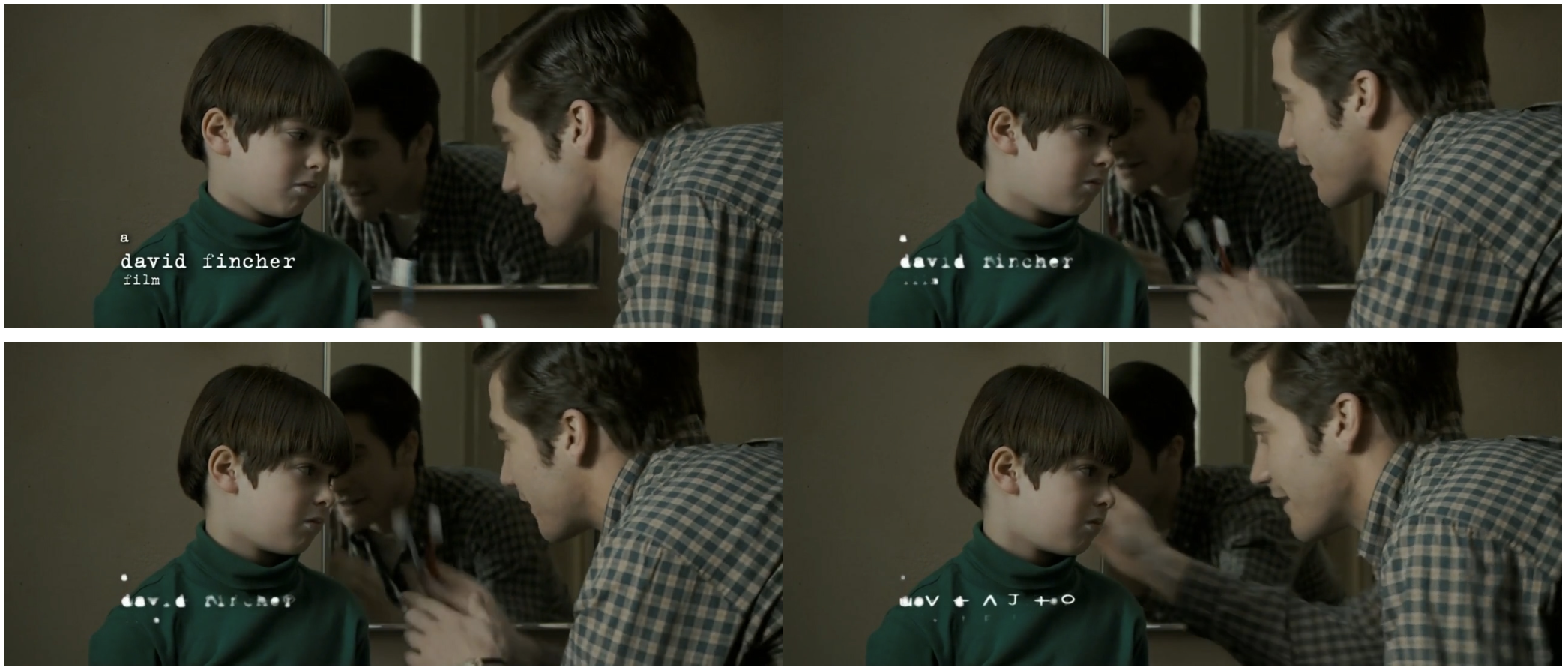
The film is a biopic chronicling the true story of the Zodiac Killer, who terrorized late-1960s America.
During editing classes, Davide Grampa presented several examples of how title graphics and studio logos have evolved into what can be seen as the film’s calling card — establishing its tone and identity from the very first frame.
In Zodiac, the typeface resembles old typewriter letters, which gradually dissolve into mysterious esoteric symbols.
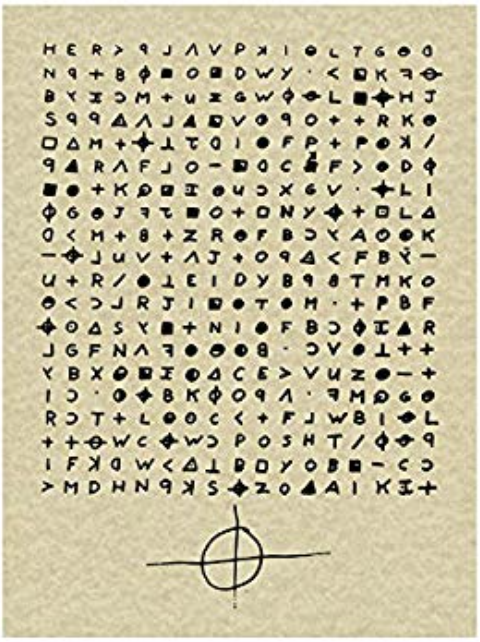
This visual combination perfectly encapsulates the essence of the story: the obsessive investigation of two journalists who try to uncover the truth behind the killer, documenting his crimes through the very medium — newspapers — that define his mythology.
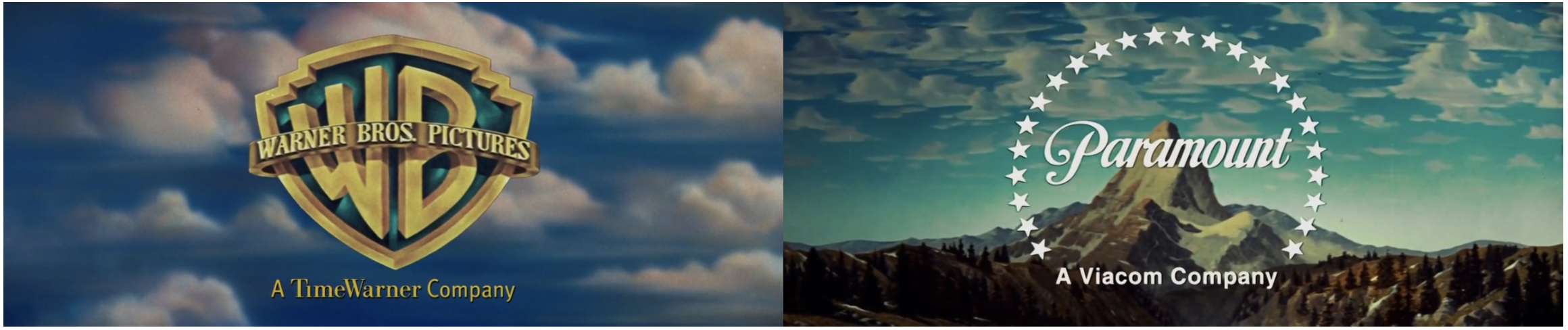
Even the studio logos at the start of the film are reworked to match the vintage aesthetic of the era — complete with film grain — despite the movie being shot digitally.
As Edoardo Colombo, professor of Film Analysis, explained, this stylistic choice may stem from the studios’ desire to appear as integrated parts of the artwork itself, rather than detached financiers.
By adopting the film’s aesthetic, the studios immerse the audience in its period atmosphere from the first seconds — signaling artistic investment rather than mere production credit.
Finally, even the placement of title sequences within a film can convey meaning — as in The Wild Bunch (1969, Sam Peckinpah).
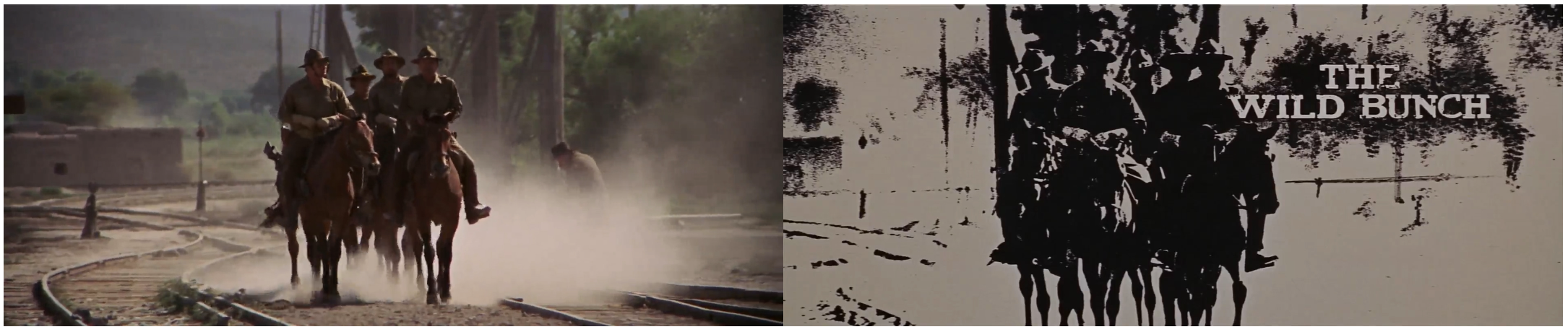
The film opens with soldiers on horseback. At first, we cannot tell whether they are the protagonists or not.
Suddenly, the motion freezes: the frame becomes posterized, sepia-toned, transforming the riders into dark silhouettes over which the title “The Wild Bunch” appears.
This juxtaposition offers several key clues:
The superimposition of the title over the riders identifies them as the story’s main characters.
The contrast between the title’s meaning and the lawmen’s uniforms creates a subtle sense of disorientation — suggesting that not everything is as it seems.
The alternating visual styles act like two sides of the same coin.
This impression is reinforced moments later, when the riders pass a group of innocent-looking children sitting in a circle — only for us to discover that they are feeding a scorpion to a swarm of ants.
The symbolism is clear: cruelty exists even in innocence, and appearances deceive.
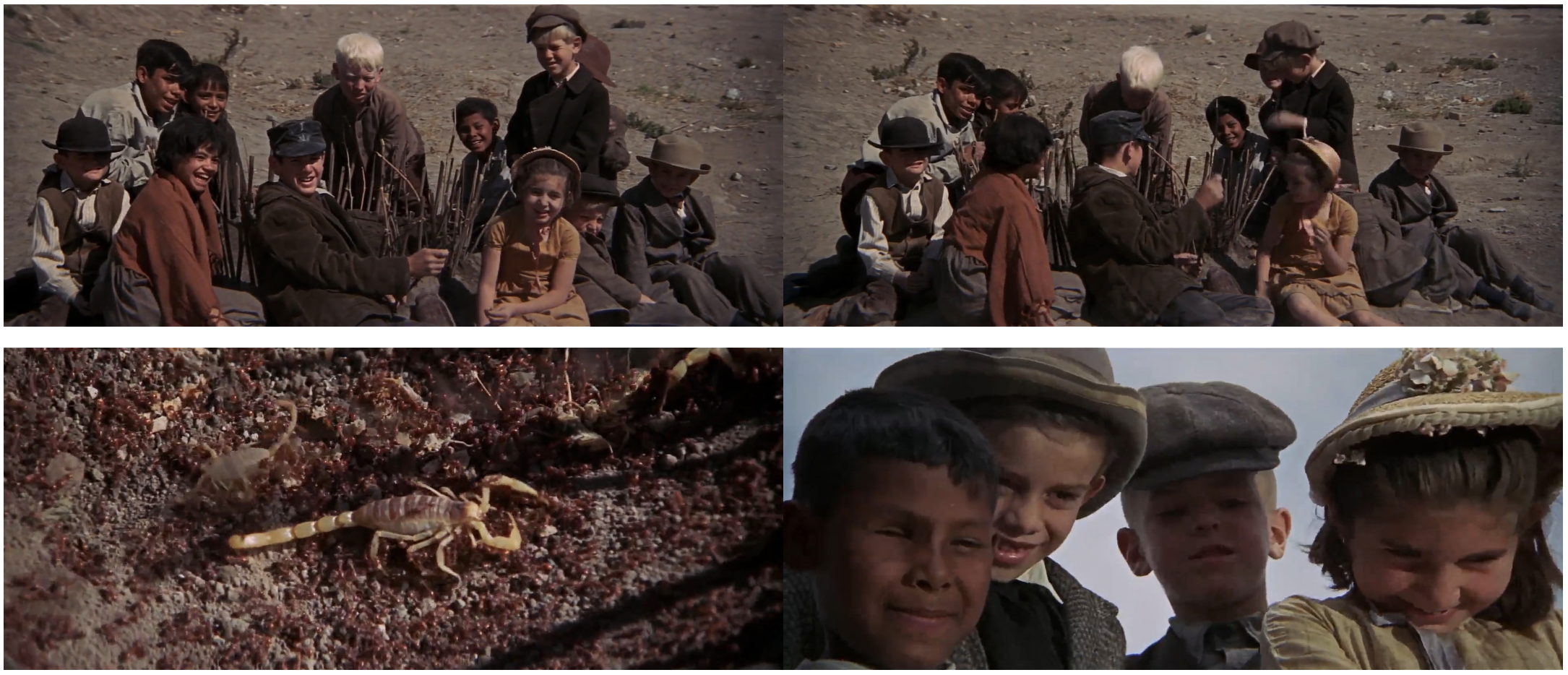
The clue provided by the title sequence is later confirmed when the soldiers enter a bank and reveal their true nature as robbers.
Throughout the narrative, this stylistic choice mirrors the film’s thematic tension: these apparent outlaws, initially portrayed as bloodthirsty bandits, gradually reveal themselves as antiheroes, capable of loyalty, honor, and emotion.
This example perfectly illustrates how visual and editorial decisions can form a cohesive and expressive unity — one that defines the film’s style, anchors the audience emotionally, and shapes the identity of the story they’re about to experience.
CREDITS:
Fight Club, David Fincher, 20th Century Fox, Regency Enterprises, Linson Films (1999)
Se7en, David Fincher, New Line Cinema (1995)
Zodiac, David Fincher, Warner Bros. Pictures, Paramount Pictures, Phoenix Pictures (2007)
The Wild Bunch, Sam Peckinpah, Warner Bros., Seven Arts (1969)



My name is Etienne Del Biaggio. I am a film editor, self-taught animator, and composer of original soundtracks based in Giubiasco (Ticino, Switzerland). After graduating in editing and video post-production from CISA in Locarno (2019), I collaborated with Béla Tarr on Alma by Dino Longo Sabanovic, presented at the Locarno Film Festival. From 2022 to 2023, I worked as lead editor at Fiumi Studios, producing documentaries and corporate videos for clients such as Siemens and EOC Ticino.
Alongside editing and music, I have developed skills in graphic design and animation, creating several animated short films. Beyond these passions, I also enjoy sharing my personal reflections on film editing through my blog The Soul Cut, with the hope of inspiring others to explore the subject.