The Soul Cut #05
by Etienne Delbiaggio | October 1st, 2025
Walter Murch asserts that the most effective editing is not the kind that draws attention to itself, but the kind that enhances the emotion of the film and leaves no lasting memory of the techniques employed once the viewing is over. However, there are types of editing that are deliberately visible, designed to emphasize the character of a given scene and its meaning. This may seem paradoxical compared to what was said at the beginning, but Murch reminds us of the essential question: What do we want the audience to feel?
Sergei Mikhailovich Eisenstein (1898–1948), considered one of the greatest theorists and pioneers of montage, developed the concept of the “montage of attractions”: cinema and theatre should act as forms of shock, shaking the spectator and forcing them to experience the emotions flashing before their eyes.
He applied this concept in his work Battleship Potemkin (1925), and over time it extended into classical cinema. A notable example can be found in the famous shower sequence of Alfred Hitchcock’s Psycho (1899–1980):
The visible editing
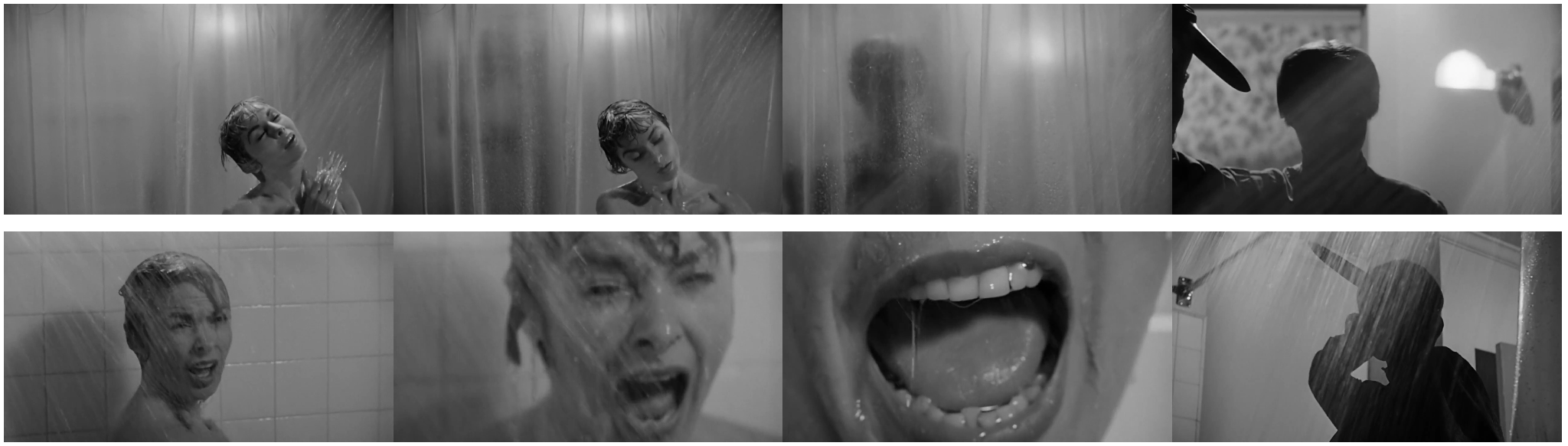
Suspense is constructed through a combination of storytelling, directing, editing, and sound, all working on the viewer’s psyche:
A. Narrative. The protagonist has just decided to redeem herself for her misdeeds. She appears as a sympathetic character to the audience, who therefore do not expect the imminent death that awaits her. Furthermore, the scene takes place in a shower—a setting tied to intimacy, with few escape routes or hiding places.
B. Directing. The camera remains with the protagonist, naked and under the shower. This helps the viewer identify with her. The composition of the first shot leaves much of the frame’s left third empty, unconsciously arousing curiosity about the space that will soon be filled by the bathroom door, as the killer enters. As the figure advances, the camera tracks forward, directing all of the spectator’s attention toward it.
C. Editing. Except for the initial cuts showing the protagonist turning on the water and starting to wash, there are no edits during the killer’s approach until the moment the shower curtain is pulled back to reveal their silhouette. This choice creates suspense: we, unlike the woman, know someone is coming, but she remains completely unaware. The cut following the curtain pull reveals her realization of the intruder’s presence, with the horror emphasized by axial cuts leading to a close-up of her screaming mouth.
D. Sound. The soundtrack initially consists only of the natural sounds of the environment. Even when the killer enters, the soundscape remains unchanged, paralleling the lack of cuts. Only at the moment of revelation—when the curtain is pulled back and the protagonist recognizes the intruder—does Bernard Herrmann’s (1911–1975) music strike, accompanied by stabbing sounds and the victim’s screams.
The attraction arises from the audience’s identification with the protagonist: a thief, yes, but one portrayed without malice and with an intention to make amends. The film actively engages the spectator, who longs to warn her of the looming danger. This construction of attraction proves fundamental for the sequence of subsequent shots.
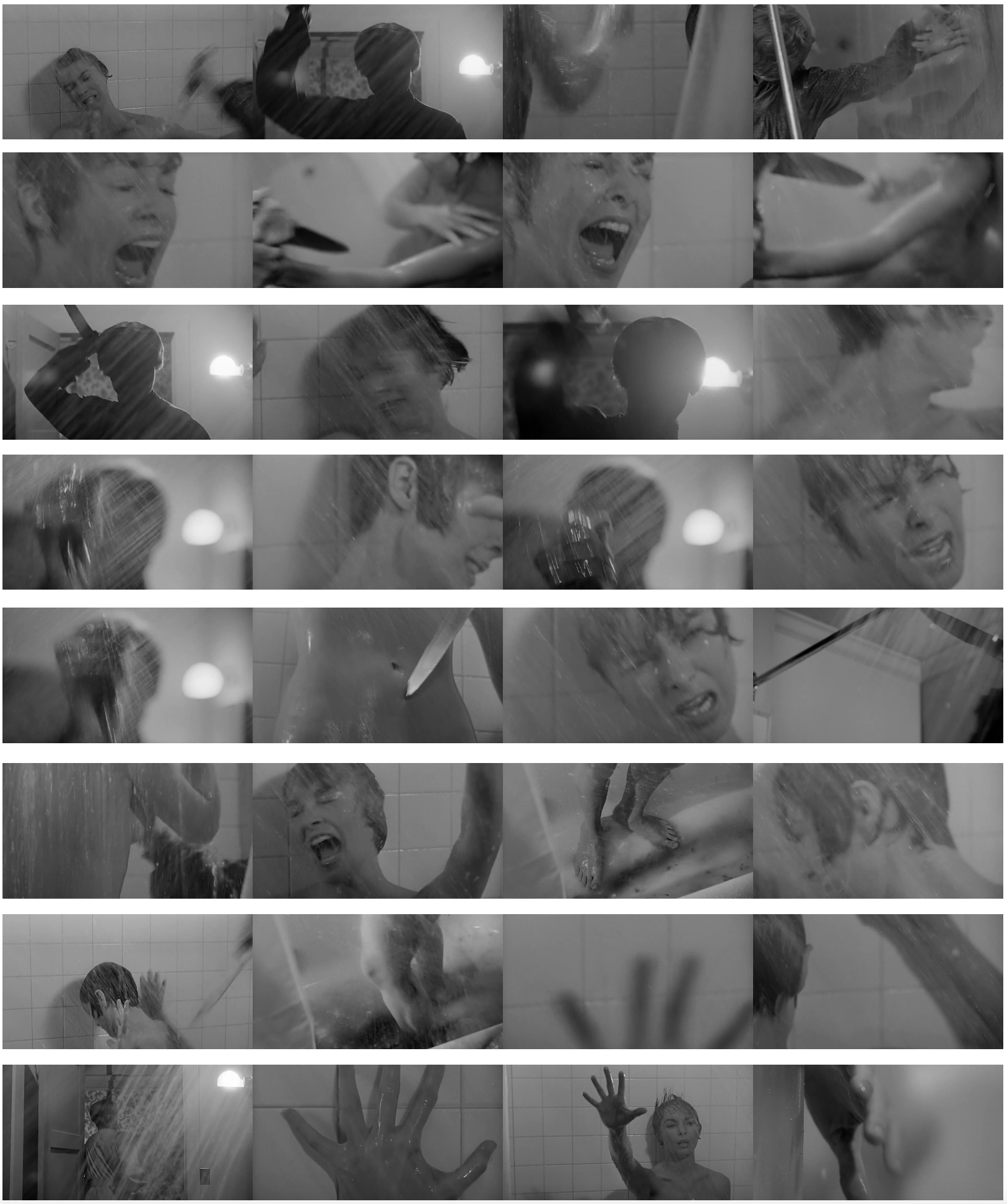
Despite the scene’s violence, only one shot explicitly shows the knife making contact with the victim’s body. The suspense built at the start suffices to immerse the audience in the action, while the frenzied rhythm of the montage—coupled with the music—creates the perception of violence. Eisenstein called this the “cine-fist”: the extremely short duration of the shots, some even blurred, generates a dynamic intensity that allows the audience, in combination with the mise-en-scène, to interpret the ferocity of the murder before their eyes. A parallel example can be found in the opening shootout of Sam Peckinpah’s The Wild Bunch (1969).
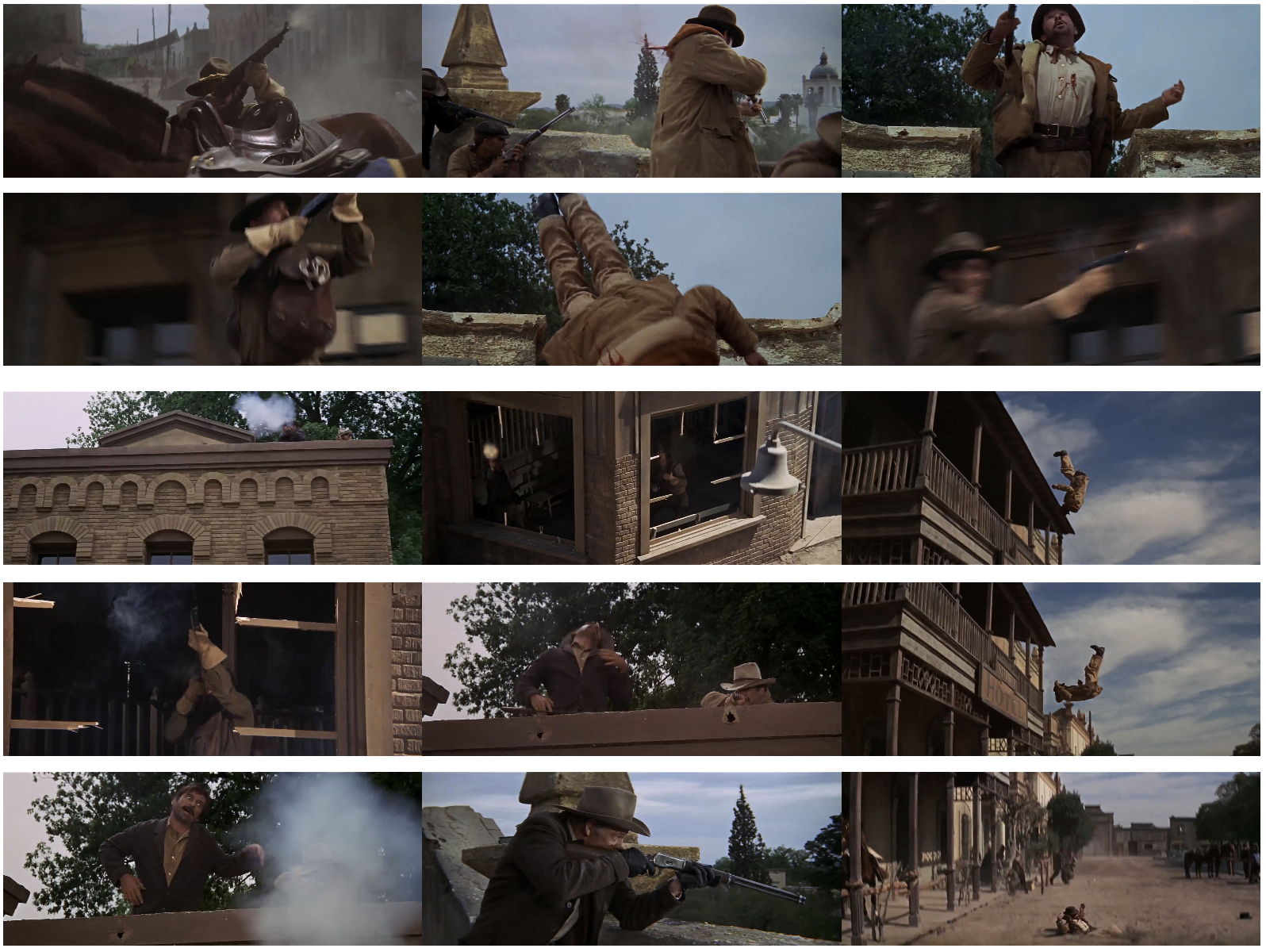
In this sequence, the same elements present in the Psycho shower scene reappear, but with an alienating addition: whereas Hitchcock’s scene presents a coherent succession of actions, Peckinpah dilates certain shots, decontextualizing them from the natural temporal order of events. For instance, a man is shot and falls from a rooftop. His fall is shown in slow motion, contrasting with the other actions depicted in real time, prolonging his death far beyond what would happen in reality.
Peckinpah developed his own view of representing violence on screen: the concept of catharsis, allowing audiences to purge their repressed aggression by witnessing graphic, violent images. Alongside the shootout’s brutality, Peckinpah stretches the moment of death, rendering it unnaturally long with slow motion. Since slow motion does not exist in nature, its acceptance by the audience is justified as an artistic license.
This demonstrates how two different styles, both originating from a shared expectation, can evoke distinct emotions: Hitchcock’s raw, merciless approach, where the murder unfolds without concession to artifice, versus Peckinpah’s stylized manipulation of time to impose new rhythms and unnatural effects. Speaking of differing styles, let us consider Gus Van Sant’s Psycho remake (1998).
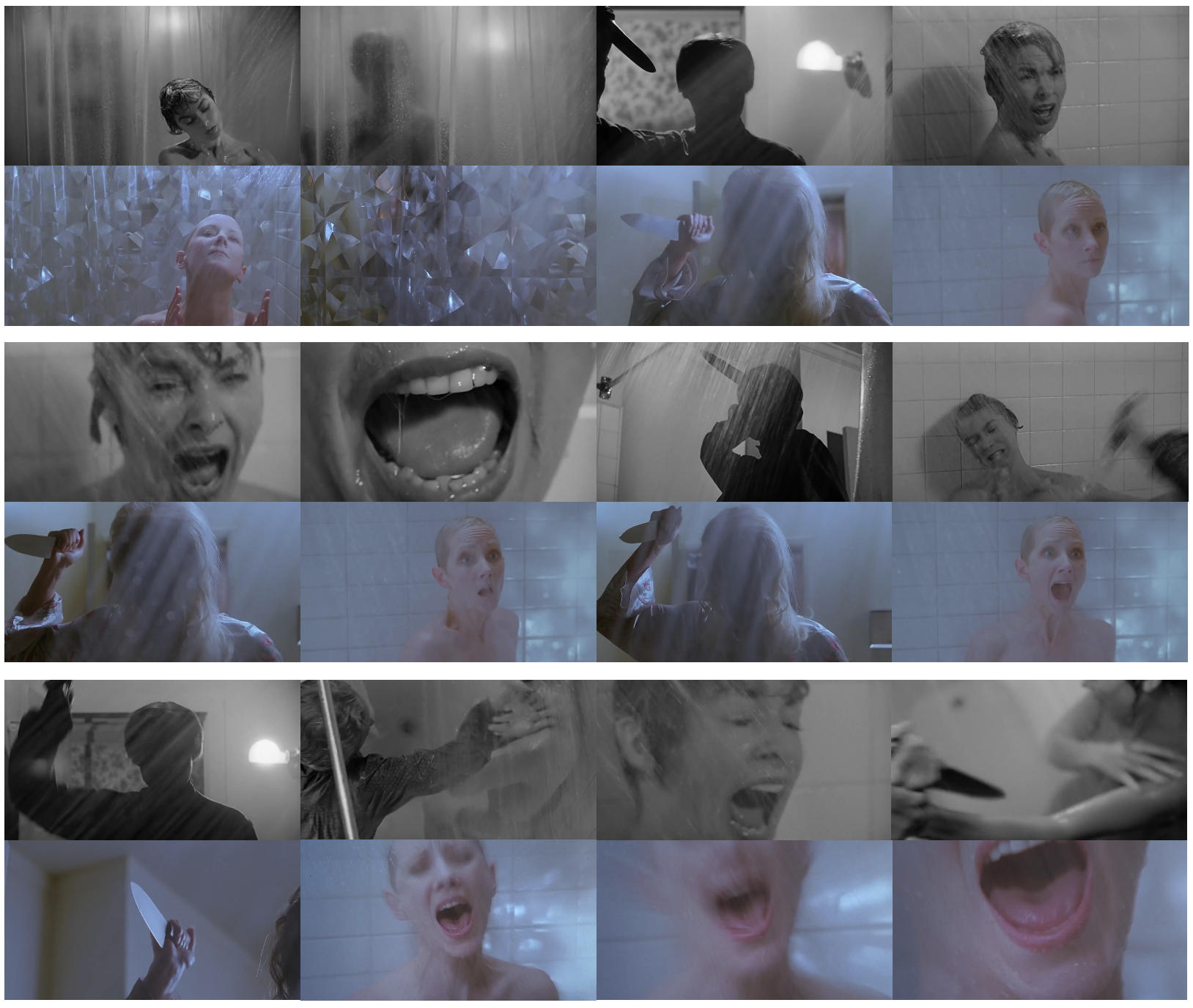
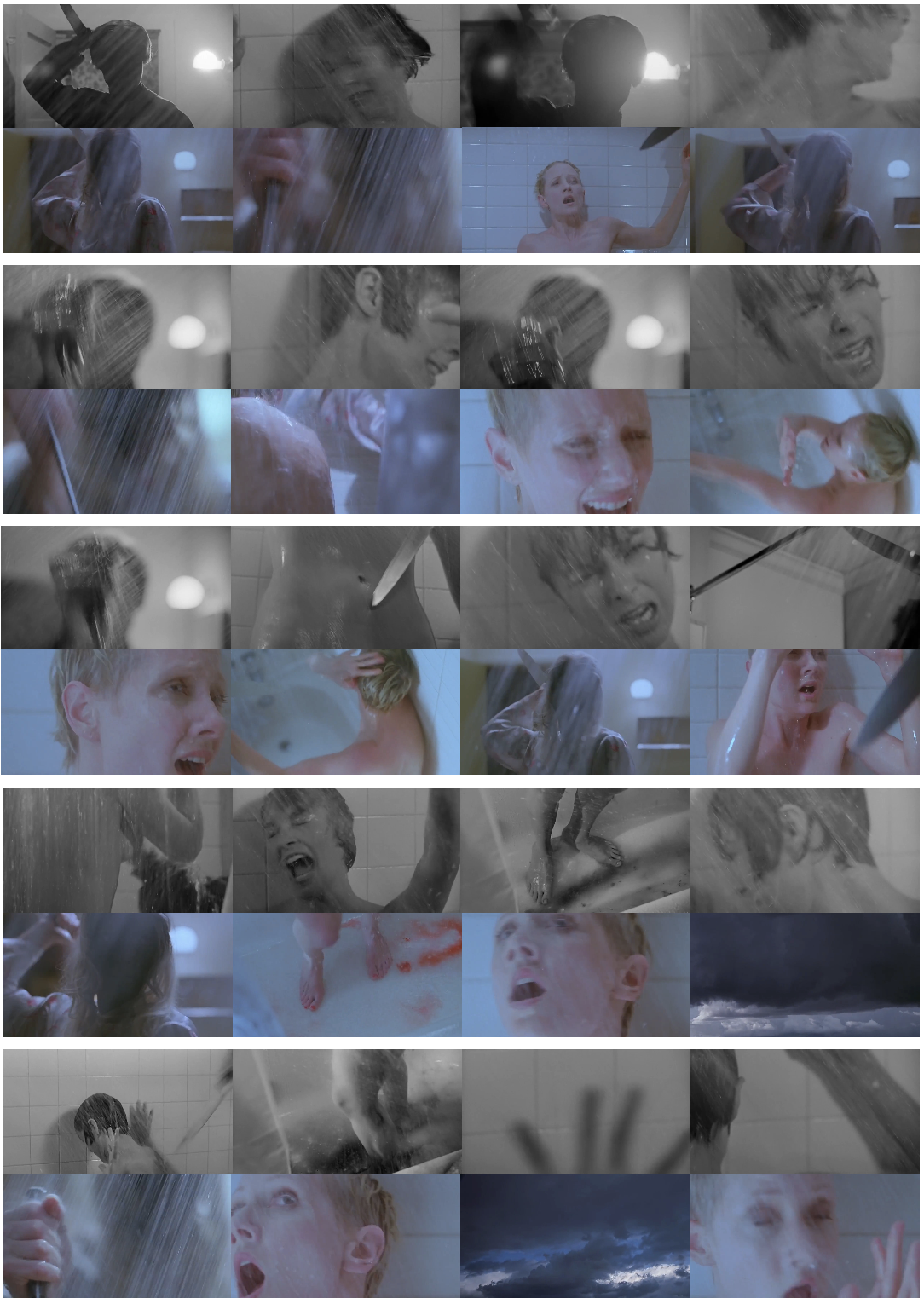
Leaving aside some updates (the addition of color, the amount of stolen money, etc.) to suit contemporary viewers, Van Sant attempts to remain faithful to Hitchcock’s vision while also adding innovations that were technically impossible in the 1960s. For instance, instead of Hitchcock’s axial cuts to the woman’s mouth, Van Sant employs a forward zoom.
Yet, even in striving for fidelity, the remake diverges significantly. In the shower scene, the timing of the shots no longer aligns perfectly. When the victim turns and first sees the killer, Van Sant delays the ensuing action, prolonging the interval between the woman’s shock and the killer’s attack. Repetition can indeed serve to reinforce a concept—much like repeating a phrase in conversation to emphasize a point. Here, the repetition aims to heighten the victim’s astonishment at the sudden appearance of her assailant.
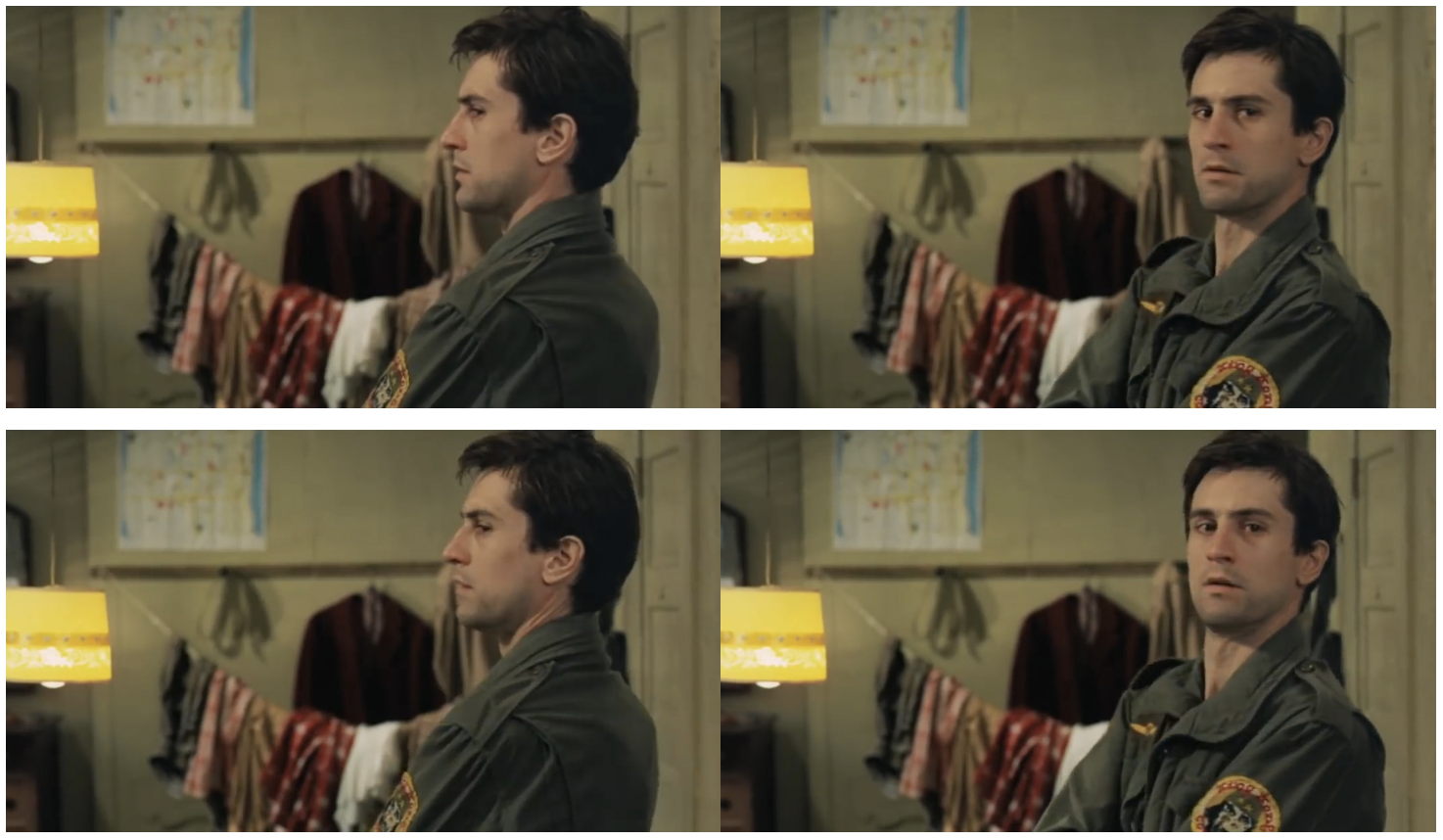
A similar technique appears in Martin Scorsese’s Taxi Driver (1976), whose protagonist suffers from schizophrenia. To highlight his mental decline, one scene repeats a simple action during an unhinged monologue, creating in the viewer the unsettling impression that something is wrong—something the human mind cannot naturally replicate.
Another striking addition in Van Sant’s Psycho is the insertion of cloud imagery intercut with the shower sequence—a stylistic signature of the director also found in works like My Own Private Idaho (1991). Aware that a faithful reproduction could not truly succeed, Van Sant infused the remake with his own style, significantly altering the original intent.
This underscores the importance of dialogue with the director to understand their personal vision of the work. Each filmmaker has unique intentions, emotions, and goals that cannot be replicated. The editor serves as the audience’s representative, mediating between the director’s message and what must ultimately reach the viewer.
Once filming is complete and post-production begins, the balance must be weighed: does the material support the director’s intention?
If the two coexist, the project can proceed in its original direction. But when the balance tilts elsewhere, in my view, the material takes precedence. New ideas and coherent forms may arise naturally from the footage, rather than forcing it to serve an imposed ideal. Of course, this depends entirely on the case at hand, as the possibilities are countless and unpredictable.
CREDITI:
Stills from Psycho, Alfred Hitchcock, Shamley Productions, Paramount Pictures (1960)
Stills from Psycho, Gus Van Sant, Imagine Entertainment, Universal Pictures (1998)
Stills from The Wild Bunch, Sam Peckinpah, Warner Bros.-Seven Arts (1969)
Stills from Taxi Driver, Martin Scorsese, Columbia Pictures (1976)



My name is Etienne Del Biaggio. I am a film editor, self-taught animator, and composer of original soundtracks based in Giubiasco (Ticino, Switzerland). After graduating in editing and video post-production from CISA in Locarno (2019), I collaborated with Béla Tarr on Alma by Dino Longo Sabanovic, presented at the Locarno Film Festival. From 2022 to 2023, I worked as lead editor at Fiumi Studios, producing documentaries and corporate videos for clients such as Siemens and EOC Ticino.
Alongside editing and music, I have developed skills in graphic design and animation, creating several animated short films. Beyond these passions, I also enjoy sharing my personal reflections on film editing through my blog The Soul Cut, with the hope of inspiring others to explore the subject.