The Soul Cut #09
by Etienne Delbiaggio | October 28th, 2025
In the language of cinema, the dissolve represents one of the most poetic and ambiguous forms of editing. It is often associated with the passage of time between one situation and another.
Personally, I tend to avoid this specific choice whenever possible, preferring a hard cut and leaving the temporal ellipsis to the viewer’s interpretation—making them more active, or guiding them through small visual clues when the material allows it.
In my view, a dissolve does not simply connect two images—it fuses them, creating a third image that strengthens the symbolic relationship between the two.
It is the moment when cinema stops showing and begins to suggest, where time no longer flows in a straight line but expands and stretches.
Throughout film history, directors and editors have used dissolves as expressive tools capable of shaping inner states, memories, and transitions between narrative or psychological dimensions.
Perhaps the most famous example is the opening sequence of Francis Ford Coppola’s Apocalypse Now (1979).
Cross dissolve
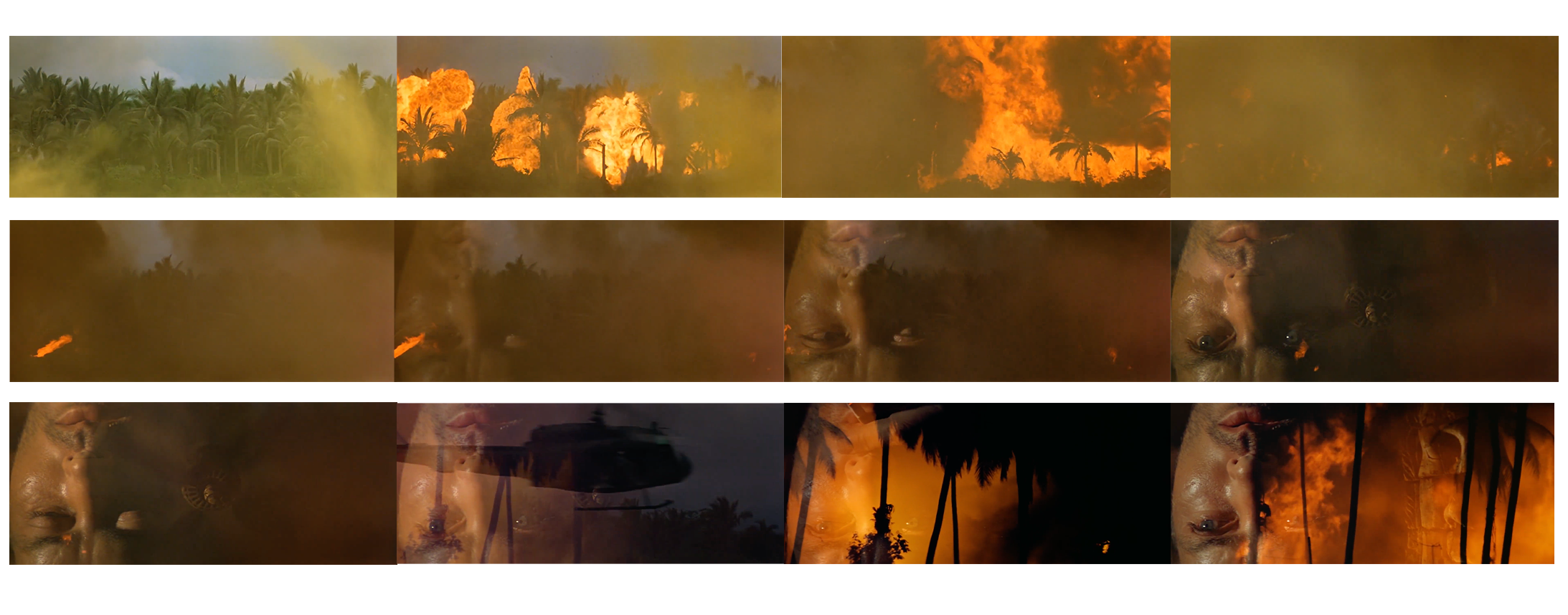
The burning palm trees of the Vietnamese jungle slowly dissolve into the face of Captain Willard, lying motionless on his hotel bed.
In this transition, war and mind become a single image: the smoke of helicopters turns into cigarette smoke, the whir of rotor blades blends with the ceiling fan.
Here, the dissolve does not act as a temporal bridge but as a sensory short circuit—it transports us directly into the disturbed mind of the protagonist, into a limbo where past and present merge in a lucid nightmare.
It’s a way of making the psychology of trauma visible—not as narrative, but as a visual experience that envelops the viewer and establishes the emotional tone that will guide the entire film.
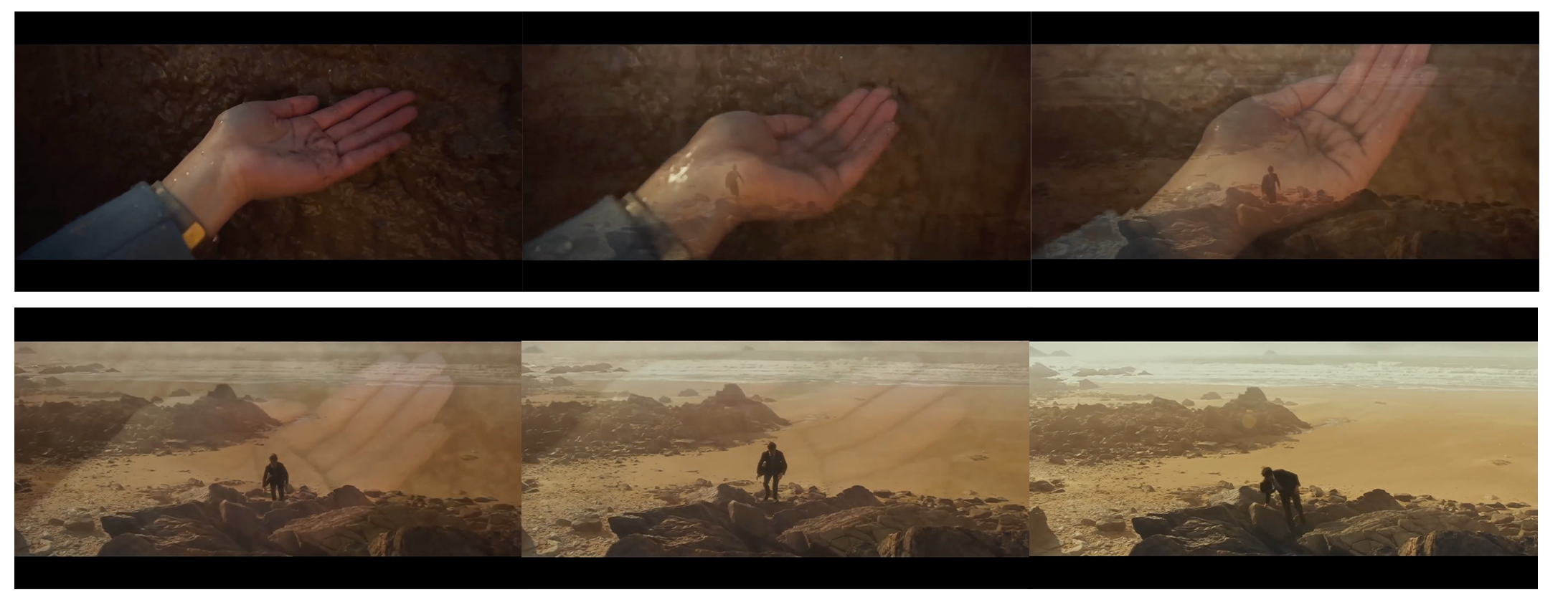
In Decision to Leave (2022), Park Chan-wook uses the dissolve as a tool of emotional connection.
The detective and the suspect are bound by a relationship of suspicion, pursuit, and desire; the cross-dissolves in the final act, bridging different spaces and times, become the invisible language of longing.
When the detective’s image dissolves into the woman’s hand during the climactic revelation—his final, desperate attempt to find her—the viewer senses the manipulation and influence she has exerted over him throughout the film, turning him into a kind of puppet in her hands.
The dissolve thus loses its technical function and becomes a grammar of emotion and revelation: the image melts away the boundary between reality and imagination.
With The Hired Hand (1971), Peter Fonda brings the dissolve into the realm of visual meditation.
Made by a filmmaker born of the America’s countercultural movement, the film fuses the aesthetics of the western with a contemplative, spiritual rhythm.
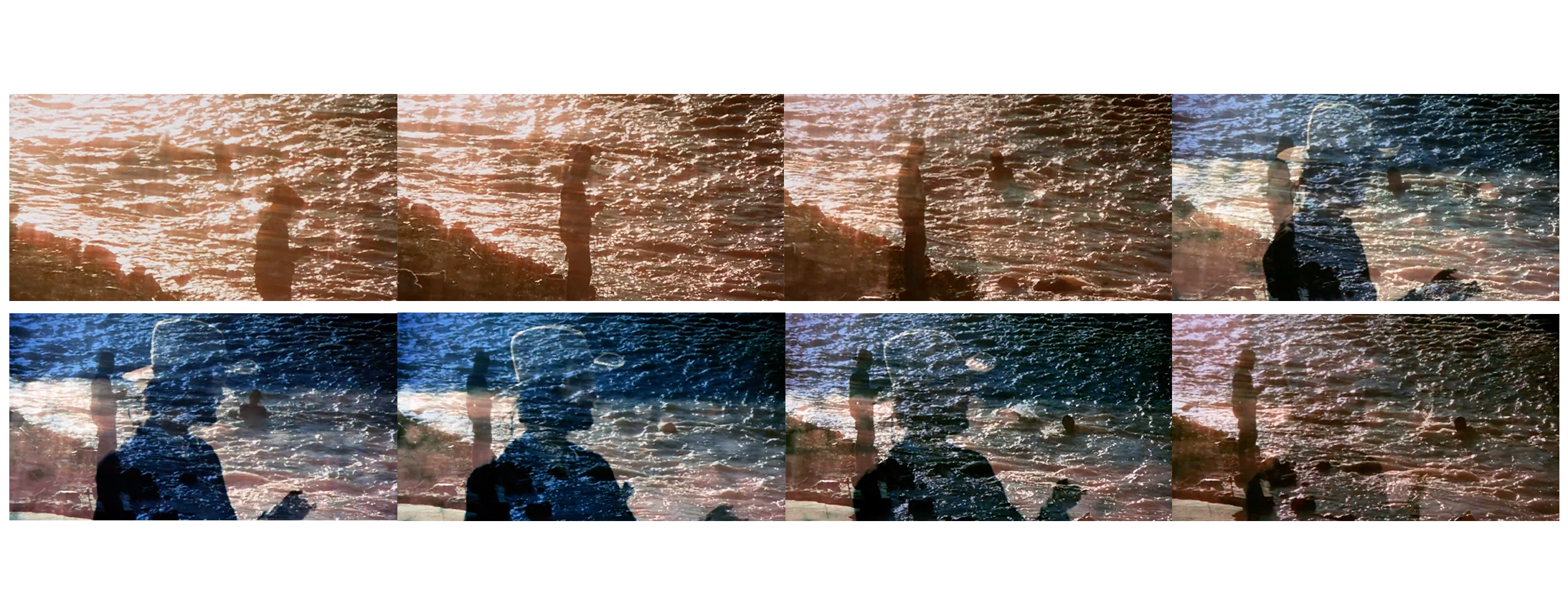
The opening sequence shows the three cowboys bathing in a river bathed in sunlight. Over this wide shot, Fonda and editor Frank Mazzola overlay close-ups of the same men engaged in the same gestures, their faces and movements echoing through time.
The choice to open the film without credits reflects the spirit of 1970s New Hollywood: the will to break convention and immerse the viewer not in a typical genre story, but in a self-contained cinematic experience with its own rhythm and message.
Fonda and Mazzola extend the transitions to the point where images overlap like visions, evoking the fragility of a wandering life and the melancholy of distance.
It is a cinema that does not race toward the future—it dissolves into the present, resembling an impressionist painting rendered on film.
In Highlander (1986) by Russell Mulcahy, the dissolve becomes an act of mythic transformation.
Transitions between eras—from 16th-century Scotland to contemporary New York—do not occur through sharp cuts but through visual fusions that suggest continuity through time and the inevitability of change.
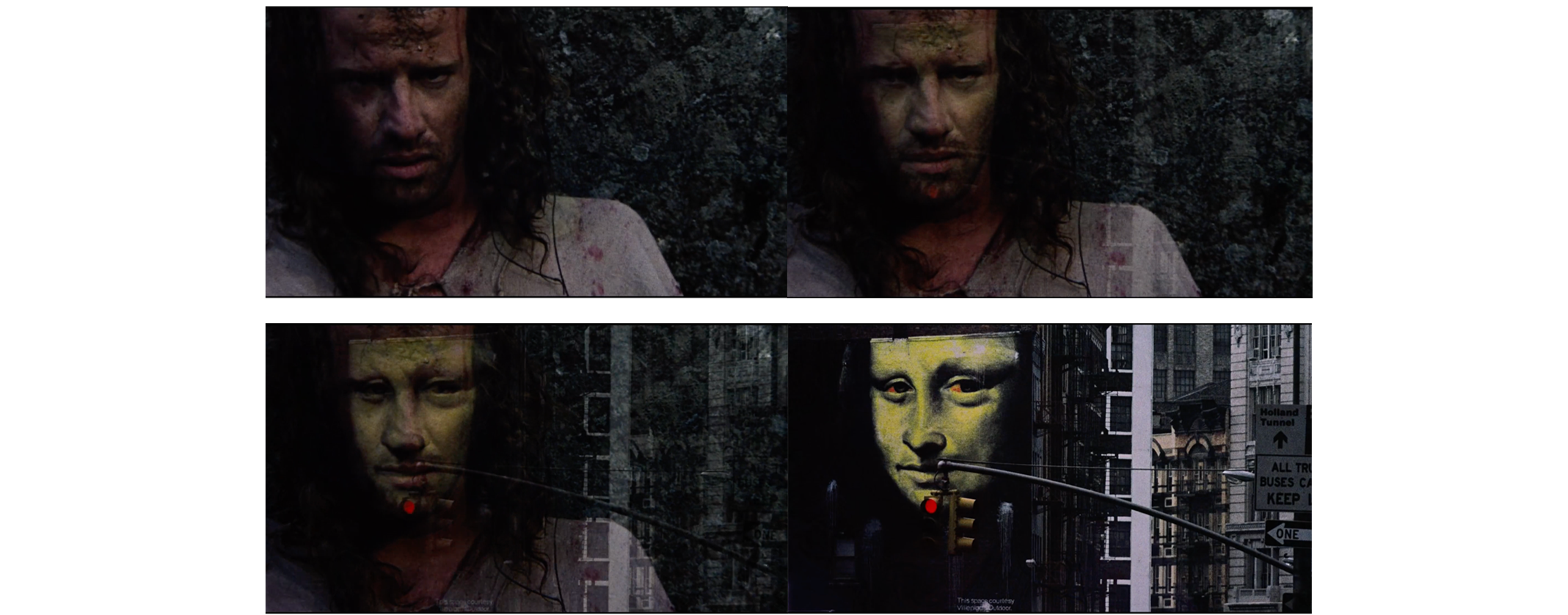
In the sequence reproduced here, Connor MacLeod, having discovered his immortality and been exiled from his village, collapses in anguish against a rock.
As the shot slowly transitions to a modern mural of the Mona Lisa, the dissolve creates a double metaphor: both the painting and the character have survived centuries, and both have suffered the erosion of meaning that comes with time.
The Mona Lisa has become a commercial icon stripped of its mystery; Connor has lost what makes him human—love and faith in others.
Coming from the world of music videos, Mulcahy uses the dissolve as a source of visual energy, but also as a poetic statement: the past doesn’t die—it reincarnates.
The transition marks not a jump, but a rebirth of the image, a cyclical flow of life and memory that defines both immortality and decay.
In Psycho (1960), Alfred Hitchcock operates with almost surgical precision.
After the shower scene, the dissolve that merges the blood swirling down the drain with Janet Leigh’s motionless eye remains one of cinema’s most iconic transitions.
It is not a mere visual link but a symbolic metamorphosis—the vortex of oblivion marking the passage from life to death, depicting the protagonist’s final heartbeat before the shot returns to her lifeless body.
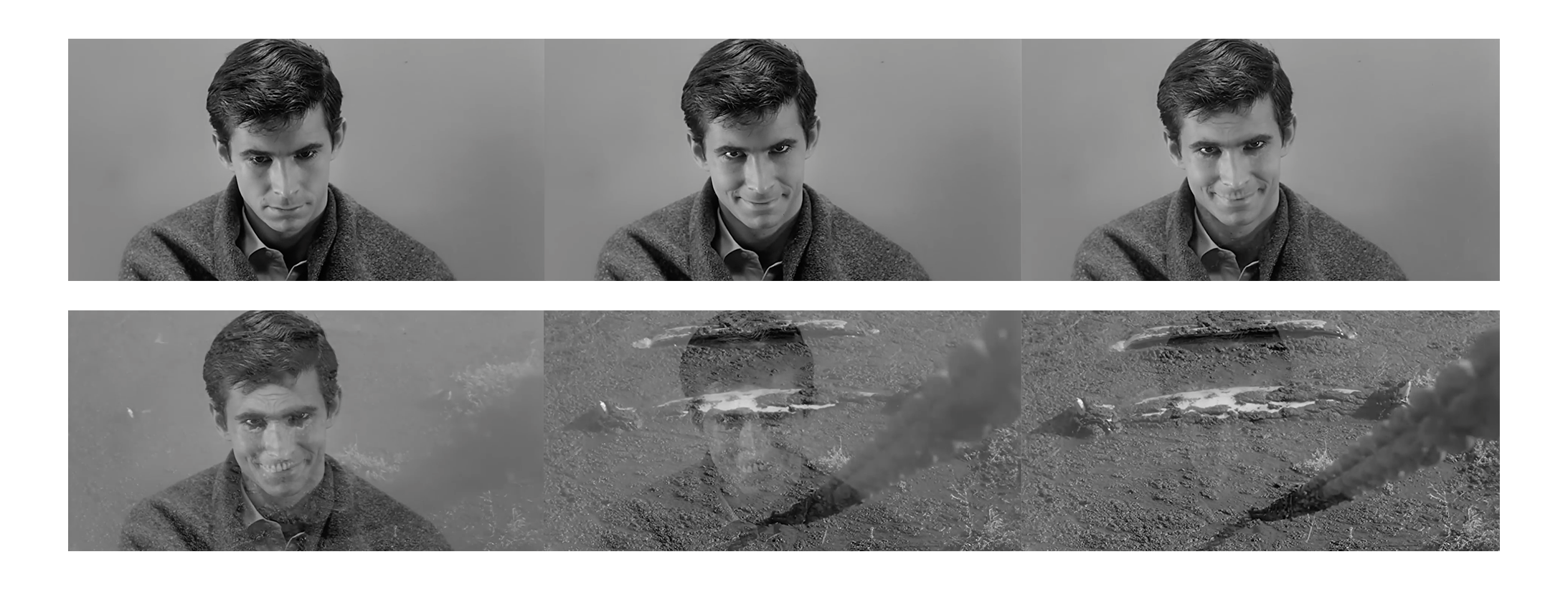
Likewise, the film’s final sequence—where Norman Bates is once again possessed by his mother’s personality—reveals this transformation only to the audience through a triple dissolve: from Norman’s face (the outer self), to the mother’s skull (the inner horror), to the car being dragged from the swamp (the evidence of their crimes).
In a single gesture, Hitchcock encapsulates horror and loss, death and guilt.
The dissolve does not soften the violence—it sublimates it, allowing the viewer to internalize the trauma without explicit depiction.
It is the moment when cinema achieves its greatest power: to evoke what cannot be shown.
From the infernal visions of Apocalypse Now to the suspended grace of Decision to Leave, from the twilight contemplation of The Hired Hand to the mythic metamorphoses of Highlander, and the psychological precision of Psycho, the dissolve reveals itself as a poetic act before a technical one.
It is the point where editing stops cutting and begins to unite—where narrative pauses and time expands.
In that moment, cinema doesn’t just tell a story: it dreams one.
CREDITS:
Apocalypse Now, dir. Francis Ford Coppola, Zoetrope Studios, United Artists (1979)
Decision to Leave, dir. Park Chan-wook, CJ Entertainment, Moho Film (2022)
The Hired Hand, dir. Peter Fonda, Universal Pictures (1971)
Highlander, dir. Russell Mulcahy, Thorn EMI Screen Entertainment, 20th Century Fox (1986)
Psycho, dir. Alfred Hitchcock, Shamley Productions, Paramount Pictures (1960)


My name is Etienne Del Biaggio. I am a film editor, self-taught animator, and composer of original soundtracks based in Giubiasco (Ticino, Switzerland). After graduating in editing and video post-production from CISA in Locarno (2019), I collaborated with Béla Tarr on Alma by Dino Longo Sabanovic, presented at the Locarno Film Festival. From 2022 to 2023, I worked as lead editor at Fiumi Studios, producing documentaries and corporate videos for clients such as Siemens and EOC Ticino.
Alongside editing and music, I have developed skills in graphic design and animation, creating several animated short films. Beyond these passions, I also enjoy sharing my personal reflections on film editing through my blog The Soul Cut, with the hope of inspiring others to explore the subject.